What It Was Like Travelling Through North Korea
- John DeCleene
- 2 days ago
- 5 min read

North Korea is one of the few places in the world that still feels genuinely unknown. Before going, I expected it to be strange, tightly controlled, and unlike anywhere I had been before. It was all of those things—but what stayed with me most was not just the politics or the spectacle. It was the feeling of stepping into a place that seemed frozen in its own reality, with its own rhythms, symbols, and rules, and knowing that almost everything I was seeing had been carefully curated for outsiders.
I visited as part of a guided trip, which is effectively the only way most foreigners experience the country. From the moment we arrived, it was clear that this was not going to be a normal form of travel. There was no wandering off on your own, no casual conversations with whoever you happened to meet, and no spontaneous detours. Every movement was structured. Every stop had a purpose. The experience was tightly framed, yet that structure only made the country more fascinating. You start paying much closer attention when you realize how little you can actually access freely.

Arrival Into a Different World
Even getting there felt surreal. The airport was quiet, sparse, and almost eerily still compared to the frantic energy of most international hubs. There was very little of the commercial clutter you expect when traveling—few people, limited signs of modern global consumer culture, and a sense that you had crossed into a parallel system. That feeling only grew stronger once we entered Pyongyang.
The city itself was striking. On one hand, there were huge boulevards, grand monuments, formal buildings, and dramatic skyline views over the river. On the other, there was an unmistakable sense of theatricality to it all, as though the capital had been arranged not only for function but for ideological presentation. Everything looked orderly, monumental, and deliberate. It did not feel chaotic or improvised. It felt staged on a national scale.
The Power of Choreography
What makes North Korea so unusual is not just that it is authoritarian. It is how visible the choreography is. In many places, power operates in the background. In North Korea, it is everywhere—on walls, in classrooms, in public squares, in metro stations, in giant portraits, in mass architecture, and in the language used to explain the country to you. You are never allowed to forget the system you are inside.
That was especially clear during visits to schools and institutions. Watching students at work—whether in art classes or computer classrooms—was one of the most memorable parts of the trip. On one level, it was easy to focus on the human side of it: young people learning, concentrating, creating, and going through the motions of school life as students do anywhere. But there was also a political layer that was impossible to ignore. The setting, the symbols in the room, the presence of officials, and the very fact that foreigners were being shown these moments all gave the experience a double meaning. It was educational, but it was also performative.
The Metro, the Monuments, and the Stagecraft
Pyongyang’s metro was one of the most visually impressive parts of the trip. Descending into those cavernous underground halls, lit by oversized chandeliers and framed by murals and monumental design, felt more like entering a ceremonial space than a transit system. It was beautiful in a grand, state-driven way—less about everyday convenience and more about projecting permanence and pride.
The monuments carried a similar effect. They were massive, unapologetic, and designed to overwhelm. Whether standing in front of huge political structures, looking over the city from above, or moving through carefully selected public sites, you could feel how deeply symbolism had been built into the urban landscape. North Korea does not really do understatement. It communicates through scale.
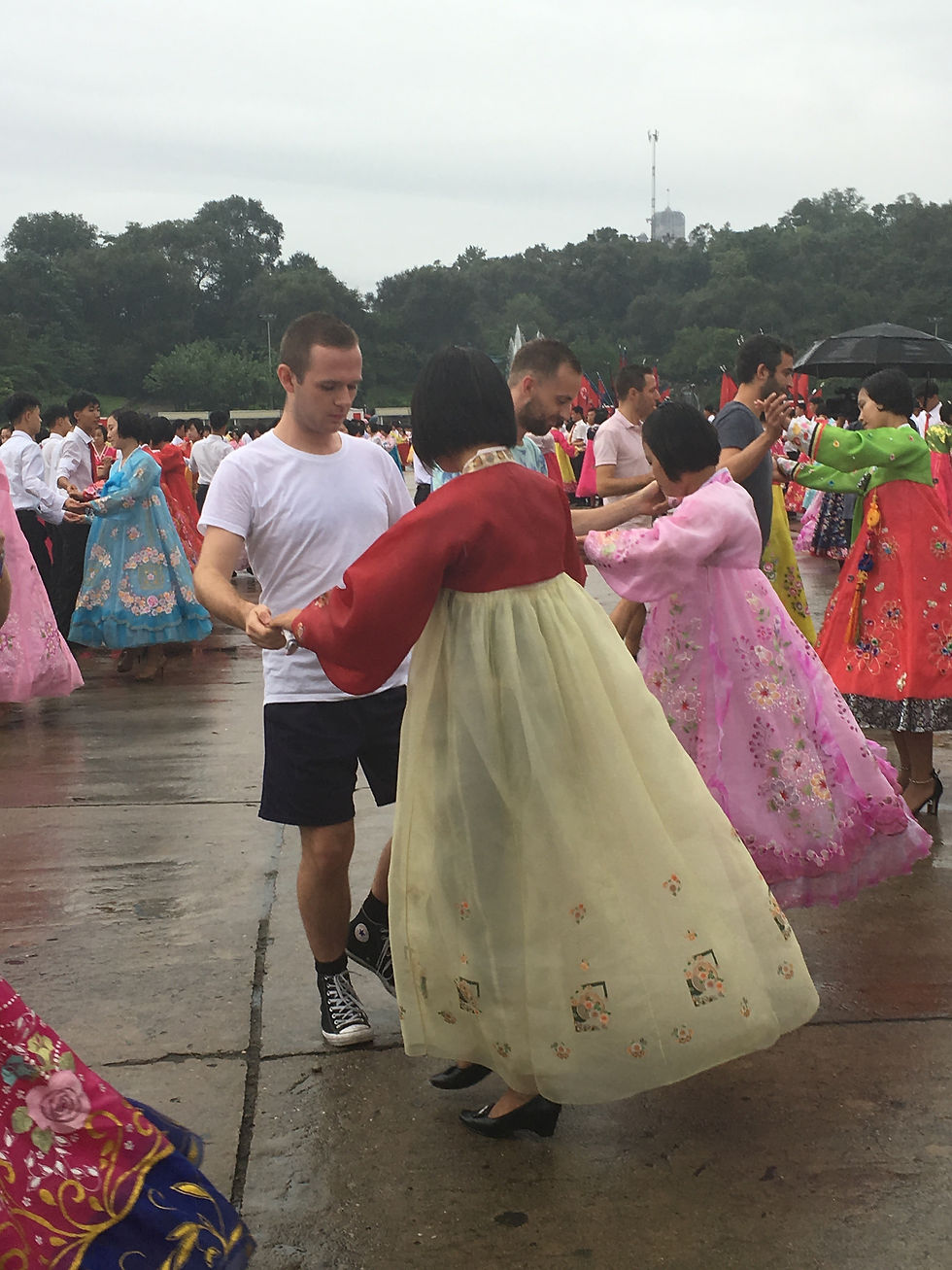
And yet, some of the strangest moments were the most ordinary-seeming ones. A classroom scene. A platform full of commuters. A dance in the rain during a public gathering. A table full of beer mugs at the Taedonggang Beer Festival. These moments stood out because they introduced flashes of normalcy within a place otherwise defined by control and narrative. They reminded me that even in a highly managed state, daily life still exists—people still laugh, socialize, work, learn, and go through familiar human routines.

What Felt Most Strange
The strangest part of travelling through North Korea was not necessarily what I saw. It was the constant awareness of what I was not seeing. You are shown a version of the country, and you know it. The guides explain things with total certainty, but you are always aware of the invisible boundaries around the experience. That tension—between what is presented and what is withheld—creates a kind of mental dissonance that is hard to replicate anywhere else.
It also makes you reflect on how travel usually works. In most countries, even if you are only there briefly, you can drift into neighborhoods, observe small details, and construct your own impression. In North Korea, that interpretive freedom is constrained. You are not just visiting a place; you are being led through an official story about that place. The result is that you leave with vivid memories, but also with more questions than answers.

The Human Side
One of the easiest mistakes when writing about North Korea is to reduce it entirely to politics. The politics matter, of course, but what lingered with me were also the human moments. Seeing students in class. Watching people on the metro. Being around locals in public spaces, even in limited ways. None of that erased the reality of the regime, but it complicated the picture in a way that pure headlines never can.
That is one reason the trip stayed with me. It challenged the instinct to flatten a country into a single idea. North Korea is unquestionably one of the most restrictive places on earth, but it is also a place where millions of people live real lives inside that system. Visiting it did not make it feel normal. If anything, it made it feel even more surreal. But it also made it harder to think about it in purely abstract terms.

Why I’m Glad I Went
I am glad I went because it was one of the few trips I have taken that genuinely altered how I think about information, presentation, and the relationship between state power and everyday life. It was not a relaxing trip. It was not an easy one to process. But it was unforgettable.
North Korea is not somewhere you go for comfort or spontaneity. You go because it is one of the most unusual geopolitical and human environments in the world, and because seeing it firsthand forces you to grapple with realities that are difficult to understand from afar. It is a place where the visible and the invisible are constantly in tension—where what is shown is fascinating, and what is hidden may be even more so.
I left with a camera full of surreal images: giant monuments, pristine formal spaces, classrooms under watchful portraits, broad empty roads, dramatic skyline views, and scenes that felt at once ordinary and highly staged. But more than the photos, I left with the memory of a country that felt almost impossibly controlled, and therefore impossible to fully know. That, more than anything, is what made the trip so compelling.
Comments